
Last updated
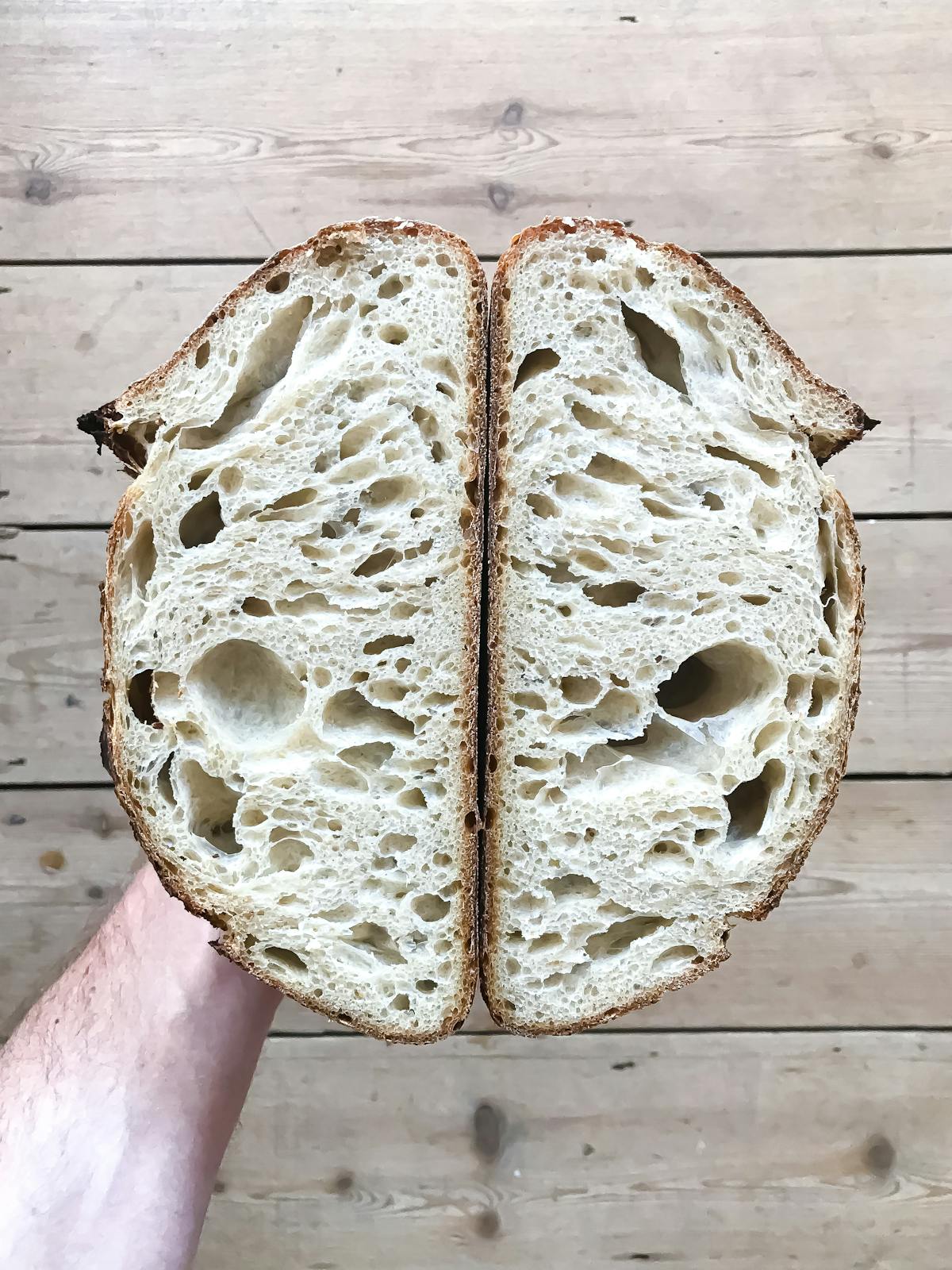
Sourdough Troubleshooting Guide
When something goes wrong with your sourdough, it's usually one of a few common issues. This guide helps you diagnose and fix them. Use our calculator for correct hydration and ratios.
My bread didn't rise
Check starter activity first—it should double in 4-6 hours after feeding. If weak, feed 1:2:2 and wait for peak. Under-proofing: dough needs ~50% volume increase and a domed top before shaping. Over-proofing: dough collapses, bakes flat. See our starter ratio and common mistakes guides.
Dense, gummy crumb
Usually under-baked, under-fermented, or too much whole grain. Bake until deeply golden; extend bulk fermentation; whole wheat needs more hydration. See our hydration guide.
Too sour / not sour enough
Fermentation time and temperature affect tang. Longer bulk = more sour. Cooler dough = milder. Adjust levain % and bulk time. See starter ratio.
Dough too sticky to shape
High hydration or flour choice. Use wet hands, bench scraper; don't add flour. Try 70-75% hydration if new. Bench rest 20-30 min before final shape. See hydration guide.
Flat loaf after scoring
Shaping tension, proofing state, or scoring depth. Build surface tension when shaping; don't over-proof; score 1-2 cm deep. See common mistakes.
Pale or thick crust
Steam, Dutch oven, or oven temp. Use a Dutch oven or steam for the first 20 min; preheat well; bake until deeply golden. See our calculator for timing.
Most sourdough problems trace back to one of three roots: an under-active starter, a temperature mismatch between the dough and the schedule, or a shaping error. The lists below give you the symptom, the likely cause, and a one-bake fix.
Three habits that quietly sabotage every loaf
- Trusting the clock over the dough. Recipes that say "bulk for 4 hours" assume 24 °C. If your kitchen is 19 °C, that 4-hour bulk needs 6 hours. Watch the dough — 50–75 % rise, smooth dome, large bubbles on the side of the bowl — not the timer.
- Adding starter "by eye". Eyeballing the закваска by the spoonful gives wildly different fermentations bake to bake. A 10 g overshoot on a 500 g recipe shifts the ferment timing by 20–30 minutes. Weigh every ingredient.
- Skipping the fold schedule. Stretch-and-folds every 30 minutes for the first 2 hours of bulk are non-negotiable for high-hydration doughs. They build the gluten you need; without them, the loaf flattens at scoring.
Specific symptoms and their fixes
- Loaf is dense and gummy inside. Underbaked or underfermented. Confirm an internal temperature of at least 96 °C / 205 °F before pulling. If the bake hit temperature but the crumb is gummy, extend bulk by 30–60 minutes next time.
- Loaf spread sideways instead of rising. Overproofed or weak shaping. End bulk earlier (closer to 50 % rise) and shape with more tension — pull the seam toward you with a bench scraper to build a tight surface skin.
- No ear, no oven spring. Underproofed dough or a too-deep score. Score with a sharp lame at a 30° angle, just 1 cm deep, and confirm the dough passes the poke test (slow spring back) before baking.
- Crust is pale and soft. Oven was too cool or the lid came off too early. Bake covered at 250 °C / 480 °F for 20 minutes, then uncovered for 25 minutes — and verify your oven temperature with a separate thermometer.
Sourdough troubleshooting FAQ
Either your hydration is too high for the flour you are using, or the bulk fermentation went too long. Drop hydration by 5 % and shorten bulk by 30 minutes — most home flours top out around 75–78 % before they become unmanageable.
The float test is unreliable. Look for a doubled starter with a domed top, large bubbles, and a sweet-tangy smell. Bake performance comes from peak activity, not buoyancy.
Overfermented. The gluten network has degraded faster than the gas can build a structure. End bulk earlier next time and consider a slightly cooler kitchen.
Internal temperature is the only reliable test. Insert an instant-read thermometer into the bottom of the loaf — 96–99 °C / 205–210 °F means done. The hollow-thump test is a rough secondary check.
You can rescue it as a focaccia or a pan loaf. Skip the shaping, transfer to an oiled pan, dimple, top with olive oil, and bake. Recovery as a boule with good crumb is usually impossible.
Related guides
Disclaimer: Baking results vary based on flour type, ambient temperature, starter health, and technique. Use this guide and our sourdough hydration calculator as a starting point, then adjust to your conditions.